You've been named, or you're about to be. Here's what that really means.
Since 28 October 2026, every business in Spain that provides addresses to companies as part of its work must name a representative to SEPBLAC, Spain's anti-money-laundering authority (Real Decreto 304/2014, art. 35.1, as amended by Real Decreto 813/2026, in force since 28 October 2026). If that person is you, start here: the worries first, then the job in plain words, then what you'll have in front of you.
See what's prepared for youFirst things first
What you're probably worrying about.
"Am I personally on the hook?"
The law can fine directors personally, but only where a breach comes from their own deliberate or careless conduct (Ley 10/2010, art. 54). Doing the job with care, and being able to show it, is the protection.
"Do I need a qualification?"
No. The law asks for the right person in the right post. There's no exam and no certificate.
"How much of my time will this take?"
For most people, very little. There are no regular reports to the authority (Real Decreto 304/2014, art. 27.3). The real work is confirming each client and looking at the occasional flag.
"What if I get it wrong?"
Mistakes happen, and the law treats people and the business differently. You can be fined personally only for deliberate or careless conduct (Ley 10/2010, art. 54). The centre itself can be held responsible even without intent. A working system, a look at what it flagged and written reasoning are your best evidence that you acted with care.
"If I report a client, will they find out? Could I be sued?"
Reports are confidential, and the law forbids anyone from telling the client (Ley 10/2010, art. 24). The law also says plainly that reporting in good faith creates no liability for the centre, its directors or its staff (art. 23).
"Doesn't naming someone put us on the radar?"
The authority will know your centre exists, and that's now true of every centre in Spain, because the law requires it of all of them. A centre whose client files are complete and up to date is in the strongest position if the authority does ask.
"What if the authority asks for something?"
You provide it completely and by the deadline it sets, and that's one export.
The job
What you actually do. And what you don't.
What you do
- Look closely at anything suspicious and write down what you found, whatever the outcome (Ley 10/2010, art. 17).
- Report to the authority without delay when there are grounds to suspect (art. 18).
- Say nothing to the client, or to anyone else (art. 24).
- Answer the authority completely, by the deadline it sets (art. 21).
- Keep your details up to date with the authority (Real Decreto 304/2014, art. 35.1).
- In a small centre, also keep an eye on the centre's own procedures.
What you don't have to do
- No monthly or regular reports to the authority (Real Decreto 304/2014, art. 27.3).
- No checking every client's documents by hand: the system runs the checks, and a person at your centre confirms each client.
- No qualification, exam or certificate.
- Until 10 July 2027, no manual, committee or external audit in a small centre (Real Decreto 304/2014, arts. 31.1 and 35.2).
Your working day
What you'll have in front of you.
Most days, nothing. When something does come up, it goes like this.
Click each point.
- Open flag
Ejemplo Servicios Atlántico, S.L.
Mail addressed to people or companies other than the client
Raised by reception · 3 Feb 2027
Never tell the client.
What you found, and what you decided
Illustration with an invented client.
Ejemplo Servicios Atlántico, S.L.
Mail addressed to people or companies other than the client
Raised by reception · 3 Feb 2027
Never tell the client.
What you found, and what you decided
The screens you'll use
Don't take our word for it. Look.
All of them show demo data.
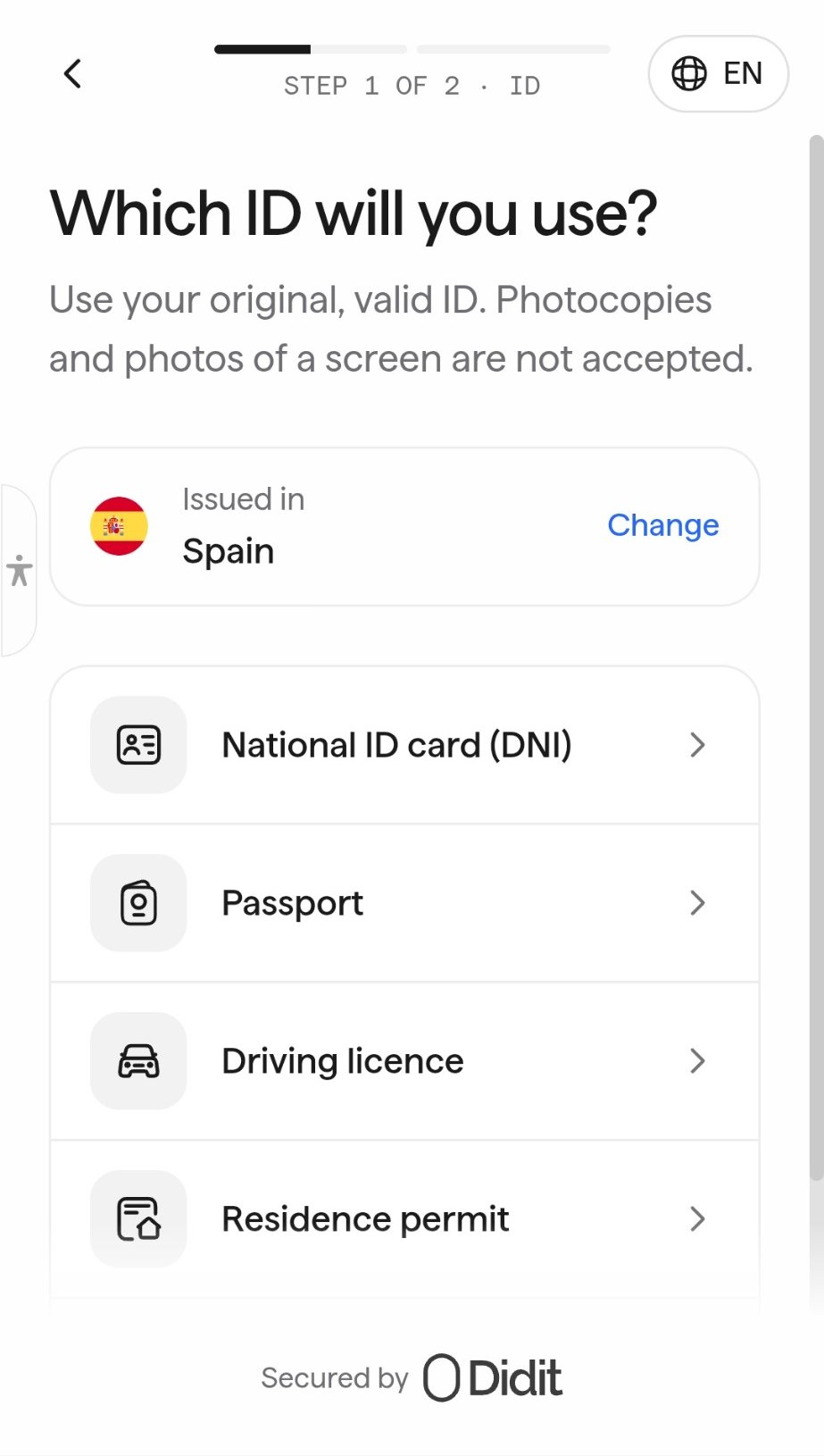
What each client goes through
The identity check on the client's own phone.
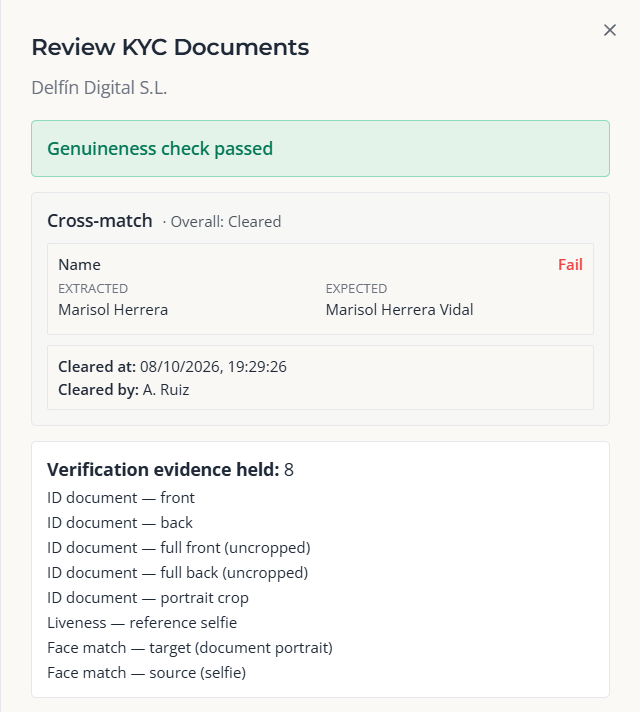
A client's file
Here a name didn't match, so one of the team looked at it, and the record shows who cleared it and when.
Compliance · Centro Ejemplo Alameda
Your representative to SEPBLAC
Marta Ejemplo Ruiz · Sole director
Lives in Spain · Evidence kept
Notified to SEPBLAC by the centre
9 Feb 2027
Authorised persons
None
Client review
Review before going live
On · each client waits for a named person
Your compliance page
Everything in one place. We'll walk you through it in a demo.What else you get
The rest of the work, already prepared.
The checks, run for you
Every one of your centre's clients is identity-checked by document, live face check and face match before being taken on. Sanctions and politically exposed persons screening repeats every day. A sanctions match stops the account automatically and tells you what to do next.
The documents, drafted
Your signed declaration, your centre's manual and risk assessment and the compliance role documents, written to Regulation (EU) 2024/1624, which applies from 10 July 2027 and prepared from your centre's details. You review and complete them, your management approves them, and they're your centre's own.
Training with a dated record
A short module that explains the job in plain language, with a signed record of who completed it and when.
Ready when the authority asks
A complete file for one client or the whole centre in one click. One search across current and past clients for the question the authority can ask: have you dealt with this person in the last ten years?
Dates that come to you
Reminders for your yearly report, and a prompt if you or your details change.
What stays yours
Flentix is never the representative. It doesn't file reports for your centre or take on its legal duties. Your centre names its own representative, you decide and sign, and your centre stays responsible. We help at every step.
Prepared for you
Not a blank page. Your documents, prepared for you.
We prepare these from your centre's details. You review and complete them, your management approves them, and they're your centre's own. We'll show you them in a demo.
Your signed declaration
Names you as the representative and confirms you meet the requirements. Your centre signs it and keeps the evidence.
Your manual
How your centre does all this, written down: who does what, how clients are checked and how a suspicion is handled.
Your risk assessment
Where your centre's risks lie, with your own figures beside each one. Your compliance officer decides every rating.
Your compliance roles
Records who holds the two roles Regulation (EU) 2024/1624 requires from 10 July 2027 (art. 11). In a small centre one person can usually do both.
A written examination
When something is flagged, this is the record of what you looked at, what you decided and why.
Your regular summary
An email with open flags and anything waiting for you, so nothing goes unnoticed.
Your yearly report
You're prompted each year, with your figures already in where they exist.
If you're choosing the person
Who it can be, and how.
- For a company: a director or manager who lives in Spain (Ley 10/2010, art. 26 ter.1).
- For a sole trader: the sole trader themself.
- It can't be an outside adviser or Flentix.
- The appointment is a signed declaration that the person meets the requirements. Your centre keeps the evidence, such as the appointment and proof of residence (Real Decreto 304/2014, art. 35.1).
- Up to two authorised people can help, proposed by a declaration the representative signs (Real Decreto 304/2014, art. 35.1).
- Small businesses have until 28 July 2027 to tell the authority who it is (Real Decreto 813/2026, second transitional provision).
- At a gestoría or law firm? If the firm provides addresses to companies, the same rule applies, and it's one representative for everything the firm does.
With Flentix, choosing the person and signing is a required step of setting up. Your notification to SEPBLAC is then prepared for you to sign and send, and your centre goes live once you upload the filing receipt. (The legal deadline for small businesses is 28 July 2027: Real Decreto 813/2026, second transitional provision.)
What's coming
From 10 July 2027: two named roles.
Regulation (EU) 2024/1624 applies directly in Spain from that date (art. 90). They create a compliance manager, who is a director, and a compliance officer, who runs things day to day. In a small business one person can usually hold both, and can also be the representative (art. 11). A small centre will also need written procedures and a written risk assessment, scaled to its size and risk (arts. 9 and 10). The drafts Flentix prepares are written to those rules.
See it for yourself.
Book a 15-minute demo and we'll show you the screens you'd actually use.
General information, not legal advice. Your own adviser can confirm anything particular to your business.